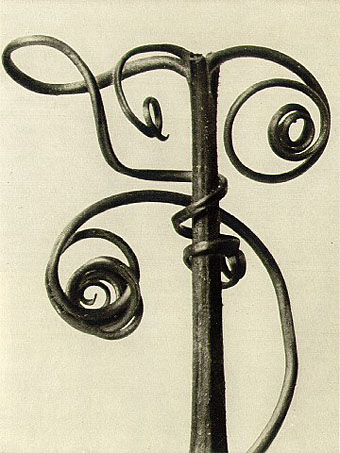
“Blossfeldt’s work can be seen as a transition between looking at photography as just science and looking at photography as art.” To me, this statement feels backward, as most people I have talked to see photography primarily as either an art form, or as an instrument of utility, depending on the circumstances. While any serious photographer would recognize the science behind every picture, I feel as though a casual observer would pay more attention to the aesthetic qualities. Blossfeldt’s photos, however, make the union of the two apparent. First, it is easy to see the artistic element of the pictures. The plants are curled into shapes we do not normally associate with them, that capture the viewer’s interest. One can almost make out a recognizable pattern among the leaves, yet nothing definitive. Black and white, set on a monochrome background, they keep the shapes the sole focus, and force the viewer to re-evaluate their expectations of what these plants “should” look like, while being intriguing to look at.
On the other hand, most of these qualities are exactly what make it a science. With a photograph of a product for an ad, for example, the viewer may know that a lot of thought went into getting the lighting, setting and angle perfect, but so much effort went into disguising all the time spent on this that it doesn’t seem to be the case. With Blossfeldt’s work, it is difficult to see the photos as anything other than time-intensive. The shape of each plant has been carefully chosen, as the most intricate and unusual that could be found. Then, they had to be set up in such a way as to cast shadows in precise locations, with precise levels of value in certain areas. Combined with the blank background, it becomes easy to see the subjects less as plants, and more as abstract, three-dimensional patterns. And yet, the patterns have an artistic quality about them. People who already view photography as just a science, perhaps the same photographers who set up such exact ads as I mentioned, can see how even contriving a scene with such precision can result in an art picture.


Nice observations, Logan. I'm happy to read your observation that choosing B&W draws more attention to the forms. I think that is right on!
ReplyDelete